Brain Activity Analysis, Modeling & Behavior Study
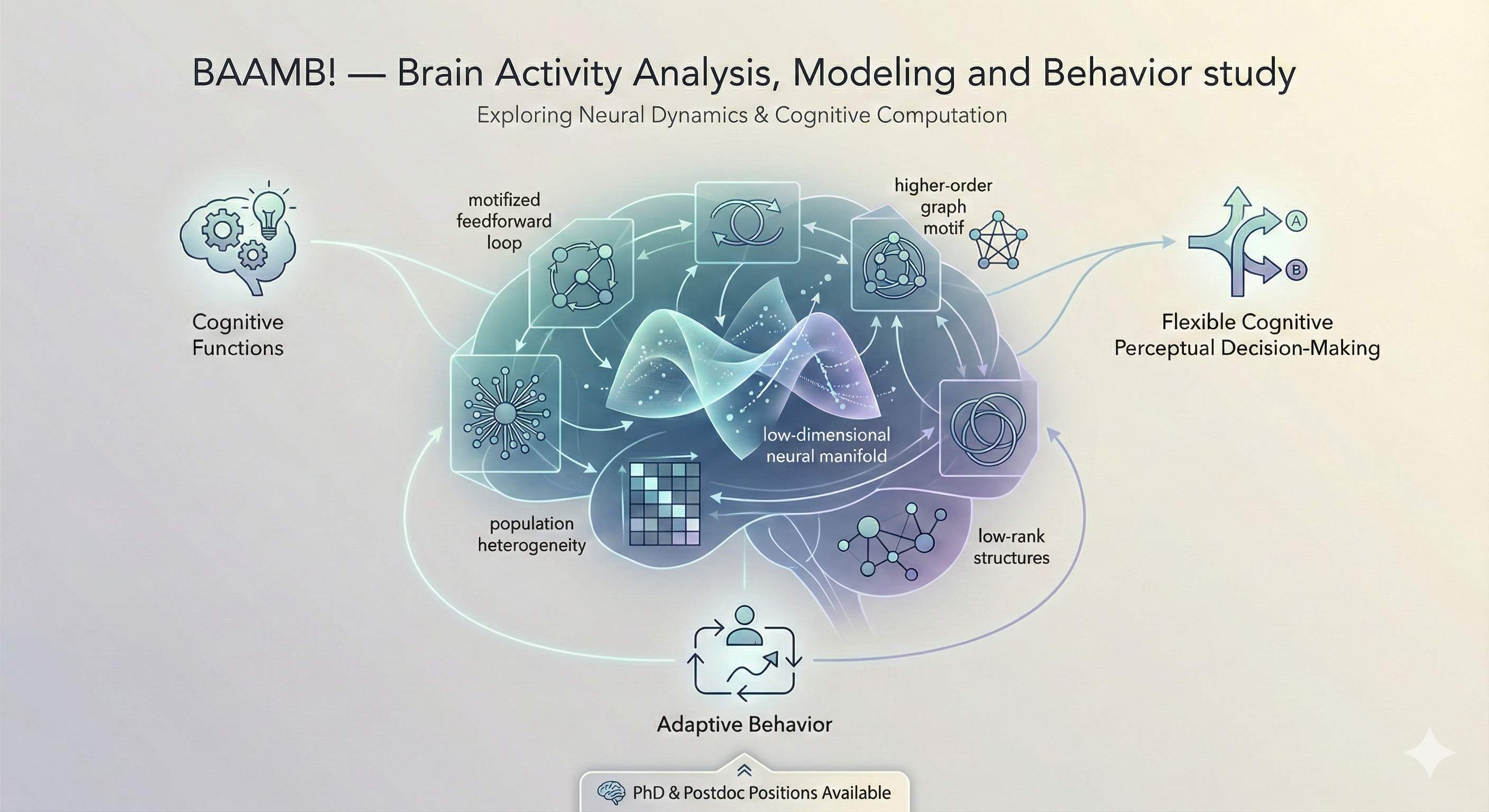
Our research integrates two lines of inquiry.
Anchored in the analysis of population activity and dynamics in brain-inspired neural networks, it moves in two complementary directions:
- developing a unified mathematical framework to reveal how structural connectivity shapes neural responses and network dynamic;
- leveraging this framework to identify the key structural features and dynamic mechanisms that support adaptive, flexible behaviors, and enable Multi-Task Learning.
Ultimately, our goal is to bridge connectivity–dynamics–behavior across scales, from microscopic to large-scale brain networks, investigating how the connectome and other biological constraints enable complex cognitive functions and behavior.
Our working styles
- Biologically‑constrained network connectivity – analytical & computational modeling of connectivity motifs (pairwise & triplet) and their impact on global dynamics.
- Neuronal computation & cognition – developing interpretable recurrent neural networks (RNNs) that mimic animal behavior and cognitive functions.
- Interdisciplinary synergy – blending mathematics, physics, neuroscience, and AI to build theory‑driven, data‑constrained models.
Current Open Positions
Open positions for PhD students are available in the following areas: theoretical/computational neuroscience,
mathematics, physics, computer science, or related fields.
Candidates with the following skills are especially encouraged to apply:
- proficiency with machine learning frameworks such as PyTorch, JAX, or TensorFlow;
- experience with recurrent neural networks and data-driven model fitting;
- background in dynamical systems or random matrix theory.
PhD Positions — Candidate Profile
I am looking for PhD candidates (with Master degree) who are excited to build theory at the
interface of mathematics, physics, and neuroscience. The ideal applicant has:
- A solid mathematics / physics foundation — comfortable with Calculus,
Linear Algebra, Probability & Statistics, and Ordinary Differential Equations,
the everyday language of network dynamics and neural population models.
- Hands-on coding ability — proficiency in Python and at least one deep
learning framework (PyTorch or JAX). Coursework in Numerical Analysis
or other computational methods is a strong plus.
- A first taste of research — a computational-neuroscience-related project
carried out during your Master’s studies (e.g., neural network modeling,
data analysis of neural activity, or dynamical-systems modeling of the brain).
You do not need to tick every box — curiosity, mathematical maturity, and a
genuine interest in understanding the brain matter most. If your background is
interdisciplinary, all the better.
Why join us?
- Access to cutting‑edge data from the LJAD and NeuroMod;
- Collaborative environment spanning physics, mathematics, and biology;
- Build connections with a network of world‑class collaborators;
- Opportunities for interdisciplinary publishing and conference participation.
How to Apply
- Prepare a CV (≤ 2 pages) and a brief statement of research interests (≤ 1 page).
- Send your application to Yuxiu.SHAO(at)univ-cotedazur.fr.
All applications will be considered confidentially and without bias.
Join us in unraveling the mathematical secrets of the brain and building the next generation of bio‑inspired intelligence.
Powered by Jekyll and Minimal Light theme.